What Is El Niño

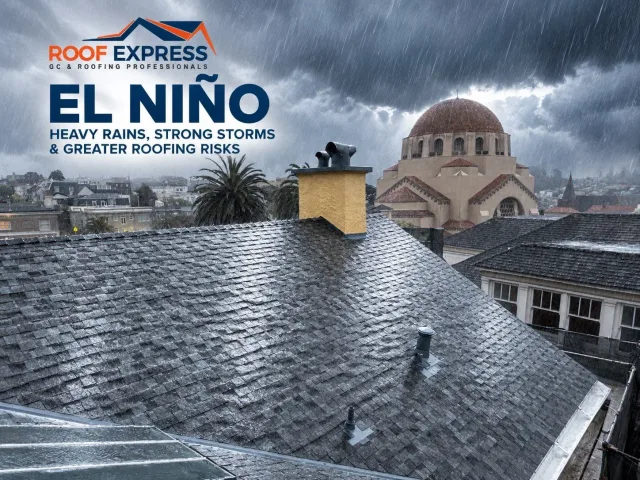
Image for a ROOF EXPRESS Field Note about roofing for San Francisco, California.
This image accompanies a ROOF EXPRESS Field Note about roofing for San Francisco, California. It is part of our collection of roofing guides and field notes.
What Is El Niño? Bay Area Rain & Roof Guide
What Is El Niño? The Complete San Francisco Bay Area Homeowner’s Guide to El Niño, Rain & Roof Protection
If you own a home or commercial property in San Francisco or the Bay Area, you have probably heard the term El Niño whenever meteorologists begin discussing the upcoming rainy season.
News reports may warn about heavier rain, powerful Pacific storms, flooding, wind, atmospheric rivers, and the possibility of an unusually active California winter.
But what exactly is El Niño?
Does El Niño automatically mean a rainy winter in San Francisco?
Can El Niño cause roof leaks?
And most importantly, what should Bay Area property owners do to prepare their roofs before the rainy season begins?
This comprehensive guide from Roof Express explains El Niño, how it develops, how it can influence California and Bay Area weather, and the steps homeowners and commercial property owners can take to reduce the risk of roof leaks and storm-related damage.
⸻
What Is El Niño?
El Niño is the warm phase of a natural climate pattern called the El Niño–Southern Oscillation, or ENSO.
ENSO involves interactions between the tropical Pacific Ocean and the atmosphere above it.
During normal Pacific Ocean conditions, easterly trade winds push warm surface water westward toward Asia and Australia. Along the western coast of South America, colder water rises from deeper parts of the ocean to replace surface water that has moved west.
This process is known as upwelling.
During El Niño, those trade winds weaken.
As the winds weaken, unusually warm surface water develops or spreads across the central and eastern equatorial Pacific. Changes in ocean temperatures then interact with the atmosphere, affecting rainfall, air pressure, winds, and large-scale atmospheric circulation.
These changes can influence weather patterns thousands of miles away—including weather across the United States and California.
El Niño is therefore much more than simply “warm ocean water.”
It is a large-scale ocean-atmosphere climate phenomenon capable of changing the probability of certain weather patterns around the world.
⸻
What Does ENSO Mean?
ENSO stands for:
El Niño–Southern Oscillation
The ENSO climate cycle generally has three phases:
El Niño
The warm phase.
Ocean temperatures across portions of the central and eastern equatorial Pacific are warmer than normal, accompanied by corresponding atmospheric changes.
La Niña
The cool phase.
Ocean temperatures in the same general region are cooler than normal, with atmospheric conditions that are generally opposite those associated with El Niño.
ENSO-Neutral
Neither El Niño nor La Niña dominates.
Ocean temperatures and atmospheric patterns are closer to their long-term averages.
It is important to understand that ENSO is a climate pattern—not an individual storm.
You cannot point to one rainstorm over San Francisco and call that storm “El Niño.”
Instead, El Niño changes large-scale atmospheric circulation and can influence the probability and location of storms over an entire season.
⸻
How Does El Niño Form?
To understand El Niño, it helps to understand what normally happens across the tropical Pacific.
Under typical conditions:
Trade winds blow from east to west across the equatorial Pacific.
Warm surface water accumulates toward the western Pacific.
Colder, nutrient-rich water rises near the western coast of South America.
Warm ocean water contributes to rising air, clouds, and tropical rainfall farther west.
Large-scale atmospheric circulation helps maintain this pattern.
During an El Niño event, the trade winds weaken.
Warm surface water moves or expands eastward across the Pacific.
The location of tropical thunderstorms and rainfall changes as well.
That enormous redistribution of ocean heat can influence atmospheric pressure and circulation patterns around the planet.
One particularly important consequence for North America involves the Pacific jet stream.
⸻
What Does the Pacific Jet Stream Have to Do With El Niño?
The jet stream is a relatively narrow corridor of powerful winds high in the atmosphere.
Its location can strongly influence where storm systems travel.
During many El Niño winters, the Pacific jet stream shifts in a way that favors a more active storm track across portions of the southern United States.
California can sometimes find itself in the path of more frequent Pacific storm systems.
That is one reason the words California and El Niño are so frequently associated with heavy winter rainfall.
However, there is an important distinction every California homeowner should understand:
El Niño increases probabilities. It does not determine the weather of every individual city, storm, or winter.
⸻
Does El Niño Mean More Rain in California?
El Niño is often associated with wetter conditions in California, particularly during stronger events.
But the relationship is not automatic.
The strength of the El Niño event, the location of warm Pacific water, atmospheric circulation, the jet stream, and other climate patterns all influence California’s actual weather.
Therefore:
El Niño does not guarantee a wet winter.
A strong El Niño may increase the chances of certain wet-weather patterns, but San Francisco could still experience periods of dry weather.
Likewise, a winter without El Niño can still produce major storms and atmospheric rivers.
For homeowners, the practical lesson is simple:
Don’t wait for an El Niño declaration before preparing your roof for winter.
A properly maintained roof should be prepared for California’s rainy season regardless of ENSO conditions.
⸻
How Can El Niño Affect San Francisco and the Bay Area?
The San Francisco Bay Area has a unique combination of geography, microclimates, coastal exposure, hills, valleys, and dense urban development.
Weather conditions can therefore vary substantially from one Bay Area community to another.
A Pacific storm may affect:
San Francisco
Daly City
South San Francisco
Pacifica
San Mateo
Burlingame
Millbrae
Redwood City
Palo Alto
Menlo Park
Mountain View
Sunnyvale
Santa Clara
San Jose
Fremont
Hayward
Oakland
Berkeley
Richmond
Marin County
and surrounding Bay Area communities
differently.
During an active rainy season, Bay Area properties may experience combinations of:
Heavy rain
Long-duration rainfall can expose weaknesses that are almost invisible during dry weather.
Wind-driven rain
Water doesn’t always fall vertically. Strong coastal winds can push rain underneath poorly installed flashing, siding transitions, vents, skylights, and roof edges.
Atmospheric rivers
Atmospheric rivers can transport enormous quantities of water vapor and produce prolonged or intense rainfall when they reach California.
Strong winds
Wind can damage shingles, flashing, gutters, vents, and other roof components.
Debris accumulation
Leaves, branches, pine needles, and other debris can block gutters and roof drainage systems.
Repeated storms
One storm may not create a major problem. Several storms arriving close together can keep roofing materials and drainage systems continuously exposed to moisture.
⸻
What Is an Atmospheric River?
You will often hear El Niño and atmospheric river mentioned in the same California weather reports.
They are not the same thing.
An atmospheric river is a long, relatively narrow region of the atmosphere that transports concentrated water vapor.
When an atmospheric river reaches California and encounters coastal terrain and mountains, that moisture can produce substantial rainfall and mountain snow.
Atmospheric rivers are responsible for a significant portion of California’s precipitation.
Some are extremely beneficial because they replenish reservoirs and snowpack.
Others can produce:
intense rainfall
urban flooding
overflowing waterways
saturated soil
landslides
falling trees
transportation disruptions
and property damage
The intensity, location, duration, and sequence of storms matter enormously.
⸻
Why El Niño Matters for Bay Area Roofs
Roofs generally do not begin leaking simply because meteorologists announce El Niño.
Instead, storms expose existing weaknesses.
A roof might appear completely functional throughout California’s dry summer months while already having deteriorated flashing, cracked sealant, blocked drainage, damaged membrane, loose shingles, or aging penetrations.
Then the first major winter storm arrives.
Water finds the weakest point.
Suddenly the homeowner notices a ceiling stain or dripping water.
That is why preventive roof inspection before the rainy season can be far less expensive and disruptive than emergency repairs during a major storm.
⸻
The Most Common Roofing Problems Exposed During Heavy Bay Area Rain
1. Damaged or Aging Roof Flashing
Flashing protects vulnerable transitions and penetrations.
It may be installed around:
chimneys
skylights
roof-to-wall transitions
vents
valleys
parapet walls
plumbing penetrations
roof edges
Improperly installed, corroded, separated, or deteriorated flashing is a common source of roof leakage.
⸻
2. Clogged Gutters
Bay Area homeowners sometimes underestimate the importance of gutters.
During heavy rain, large amounts of water must move from the roof into gutters and safely through the downspouts.
Leaves and debris can restrict that flow.
When gutters become clogged, water may overflow against fascia boards, siding, foundations, or other building components.
Cleaning the gutters before the rainy season is one of the simplest preventive maintenance steps a homeowner can take.
⸻
3. Blocked Downspouts
A clean gutter isn’t enough.
The downspout must also remain clear.
Water needs an unobstructed path away from the roof.
Roof drainage should be inspected as a complete system:
Roof → gutter → outlet → downspout → safe drainage location
⸻
4. Flat Roof Drainage Problems
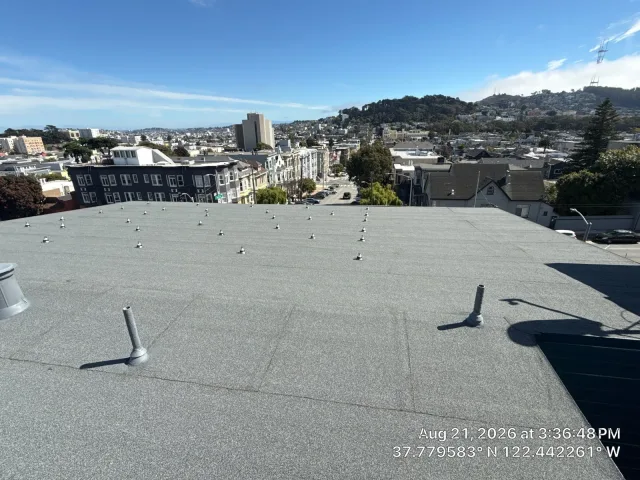
Flat and low-slope roofs are extremely common throughout San Francisco.
Despite the name, a properly designed “flat” roof should still have sufficient slope and drainage to move water toward drains, scuppers, or gutters.
Potential problems include:
clogged roof drains
blocked scuppers
inadequate drainage
deteriorated roofing membrane
failed seams
deteriorated flashing
ponding water
damaged penetrations
cracked roofing material
Standing water can increase stress on an already compromised roofing system.
⸻
5. Skylight Leaks
Skylights are another common leak location.
The skylight itself isn’t always the problem.
Water intrusion may result from:
deteriorated flashing
failed seals
damaged roofing around the skylight
improper installation
cracked components
deteriorated curb details
A roofing professional should evaluate the entire skylight assembly rather than simply applying sealant without identifying the source of the leak.
⸻
6. Roof Vent and Pipe Penetration Leaks
Every penetration through a roof creates a location that must be properly waterproofed.
Common penetrations include:
plumbing vents
exhaust vents
attic vents
mechanical equipment
electrical penetrations
solar attachments
Boots, flashings, sealants, and roofing around these areas can deteriorate with age.
⸻
7. Missing or Damaged Asphalt Shingles
Strong winds can expose problems with aging or improperly secured shingles.
Possible warning signs include:
missing shingles
lifted shingles
cracked shingles
exposed fasteners
excessive granule loss
deteriorated ridge caps
damaged roof edges
Once the water-shedding surface becomes compromised, wind-driven rain may penetrate the roofing system.
⸻
8. Modified Bitumen and Flat-Roof Membrane Problems
San Francisco contains many buildings with low-slope or flat roofing systems.
Modified bitumen and similar roofing systems can provide excellent protection when properly installed and maintained.
However, older systems may eventually develop:
open seams
cracking
blistering
punctures
deteriorated flashing
failing transitions
drainage problems
These defects may become obvious only during prolonged rainfall.
⸻
9. Chimney Leaks
Water appearing near a chimney does not necessarily mean the chimney itself is leaking.
The problem could involve:
chimney flashing
counterflashing
roofing around the chimney
sealant
masonry
chimney cap
nearby roof penetrations
Correct diagnosis matters.
Simply applying roofing cement to the visible area may temporarily hide the problem without resolving the actual water-entry point.
⸻
10. Roof-to-Wall Flashing Problems
Bay Area architecture can involve complicated roof designs, additions, decks, parapets, walls, and multiple roof levels.
Anywhere a roof intersects a vertical wall requires careful waterproofing.
Heavy wind-driven rain can reveal weaknesses in these transitions.
⸻
Warning Signs Your Roof May Not Be Ready for Heavy Rain
Bay Area homeowners should watch for:
ceiling stains
bubbling or peeling interior paint
damp attic insulation
musty attic odors
visible roof membrane damage
missing shingles
cracked roofing
deteriorated flashing
water stains around skylights
overflowing gutters
clogged downspouts
ponding water on flat roofs
damaged fascia
deteriorated sealant
water marks around roof penetrations
Do not assume a small stain means a small roofing problem.
Water can travel along framing, decking, pipes, or other building components before becoming visible inside the home.
The visible stain may therefore be located some distance from the actual roof penetration.
⸻
How to Prepare Your Roof for an El Niño or Bay Area Rainy Season
Schedule a Professional Roof Inspection
A roof inspection before the rainy season can identify vulnerabilities while conditions are still dry enough for repairs.
The inspection should evaluate the overall roofing system, not simply the visible surface.
Important areas include:
roof covering
flashing
penetrations
vents
skylights
valleys
gutters
downspouts
drains
scuppers
parapet walls
transitions
exposed fasteners
visible deterioration
⸻
Clean Gutters and Downspouts
Do this before prolonged rain begins.
A roof drainage system needs enough capacity to move water away from the building.
For properties surrounded by trees, additional cleaning may be required during the rainy season.
⸻
Inspect Roof Drains and Scuppers
This is particularly important for San Francisco flat roofs.
Even a properly installed roof can experience drainage problems when leaves and debris block outlets.
Drains and scuppers should remain clear so water can leave the roof efficiently.
⸻
Check Skylights
Inspect skylights for signs of:
deteriorated seals
damaged flashing
cracks
previous water intrusion
aging components
If you already see staining around a skylight, investigate it before the next major storm.
⸻
Repair Known Leaks Before the Next Storm
A previous roof leak should not be ignored simply because it stopped raining.
When the weather clears, the water may disappear while the underlying defect remains.
The next storm can reopen the same problem—and potentially make it worse.
⸻
Trim Dangerous Tree Branches
Trees can create several roofing hazards during storms.
Branches can:
scrape roofing materials
fall onto the roof
clog gutters
block roof drains
damage skylights
Tree work should be performed safely by appropriately qualified professionals.
⸻
Don’t Wait Until the First Major Storm
Roofing contractors can become extremely busy during prolonged rainy periods.
If thousands of Bay Area homeowners discover leaks during the same storm, emergency service demand can rise quickly.
Preventive maintenance gives homeowners more time to evaluate problems and make appropriate repairs.
⸻
Flat Roofs in San Francisco Require Special Attention
San Francisco’s housing stock includes many buildings with flat or low-slope roofs.
These roofs require particularly careful attention to drainage and flashing.
Important components may include:
roof drains
scuppers
gutters
downspouts
parapet walls
edge metal
penetrations
modified-bitumen seams
skylight curbs
roof-to-wall transitions
Unlike a steeply pitched roof, where gravity quickly moves water downward, a low-slope roofing system may drain more slowly.
That makes proper installation, drainage, and maintenance especially important during prolonged Bay Area rain.
⸻
What Should You Do If Your Roof Starts Leaking During a Storm?
First, protect people and property inside the building.
Move furniture, electronics, and valuable belongings away from the affected area when it is safe to do so.
Use containers to collect dripping water if appropriate.
Avoid electrical fixtures or wiring affected by water.
Most importantly:
Do not climb onto a wet roof.
Wet roofing materials can be extremely slippery.
High winds, rain, poor visibility, and steep surfaces make storm-time roof access dangerous.
Contact a qualified roofing contractor to determine the appropriate next step.
⸻
Emergency Roof Repair vs. Permanent Roof Repair
Emergency work and permanent repair are not necessarily the same thing.
During active rain, conditions may prevent a contractor from completing the ideal permanent repair.
A temporary emergency measure may be needed to reduce additional water intrusion until the roof is dry enough for proper evaluation and repair.
After the storm, the roof should be reassessed to determine whether a permanent repair or replacement is necessary.
⸻
Does One Roof Leak Mean You Need a New Roof?
Not necessarily.
Some leaks can be repaired locally.
Whether repair or replacement makes sense depends on factors such as:
age of the roof
roofing material
extent of deterioration
number of leak locations
condition of the roof deck
condition of flashing
previous repairs
drainage
installation quality
remaining expected service life
A professional roof inspection can help determine whether targeted repair or complete replacement is the more appropriate approach.
⸻
El Niño vs. La Niña: What’s the Difference?
The easiest way to remember the difference is:
- ●Climate Pattern | Tropical Pacific Conditions | General Description
- ●El Niño | Warmer than average | Warm phase of ENSO
- ●La Niña | Cooler than average | Cool phase of ENSO
- ●ENSO-Neutral | Near average | Neither phase dominates
Both El Niño and La Niña can affect weather around the world.
Neither should be interpreted as a guaranteed forecast for a particular Bay Area property.
⸻
Does a Strong El Niño Guarantee Heavy Rain in San Francisco?
No.
This is one of the most important misconceptions about El Niño.
Climate forecasts describe probabilities and tendencies.
They cannot tell a homeowner months in advance exactly how much rain will fall on a particular house in:
San Francisco
Oakland
San Jose
Daly City
Pacifica
Palo Alto
Fremont
or another Bay Area community.
El Niño is one important part of the climate system, but it is not the only factor affecting California weather.
⸻
Can El Niño Cause Roof Damage?
El Niño itself doesn’t physically damage a roof.
The weather patterns associated with an active winter can expose or worsen roofing problems.
For example:
Heavy rainfall can reveal failed flashing or membranes.
Strong winds can affect loose shingles and roofing components.
Repeated storms can expose a compromised roofing system to moisture again and again.
Blocked drainage can cause water to accumulate where it should not.
Falling branches can cause physical damage.
This is why the condition of the roof before winter is so important.
⸻
What Types of Roofs Should Be Inspected Before Bay Area Winter?
Practically every roof can benefit from periodic inspection, especially older roofing systems or roofs with a history of leakage.
Roof Express works with roofing systems commonly found throughout the Bay Area, including:
asphalt shingle roofs
modified bitumen roofs
flat roofs
low-slope roofs
residential roofing systems
commercial roofing systems
Roof components such as skylights, flashing, gutters, downspouts, drains, scuppers, and penetrations should also be considered as part of the overall waterproofing system.
⸻
Bay Area Roof Maintenance Checklist Before Heavy Rain
Before the rainy season, consider checking the following:
Roof surface condition
Missing or damaged shingles
Modified-bitumen seams
Flashing
Chimney flashing
Skylight flashing
Plumbing penetrations
Roof vents
Roof drains
Scuppers
Gutters
Downspouts
Roof edges
Parapet walls
Roof-to-wall transitions
Ponding-water locations
Debris accumulation
Previous leak locations
Interior ceiling stains
Attic moisture
The goal is to identify small problems before heavy rain turns them into larger problems.
⸻
Frequently Asked Questions About El Niño and Bay Area Roofing
What exactly is El Niño?
El Niño is the warm phase of the El Niño–Southern Oscillation (ENSO), a naturally occurring ocean-atmosphere climate pattern in the tropical Pacific. Warmer-than-average ocean temperatures and associated atmospheric changes can influence weather around the world.
How often does El Niño happen?
El Niño events occur irregularly rather than according to a fixed schedule. They generally occur every few years and can vary considerably in strength and duration.
How long does El Niño last?
Many El Niño events last approximately nine to twelve months, although individual events can persist longer.
Does El Niño always cause heavy rain in San Francisco?
No. El Niño can influence the probability of wetter California conditions, particularly during some stronger events, but it does not guarantee above-average rainfall in San Francisco or the Bay Area.
Does El Niño cause atmospheric rivers?
El Niño and atmospheric rivers are different phenomena. ENSO can influence large-scale atmospheric patterns, while atmospheric rivers are concentrated corridors of atmospheric moisture. California can experience significant atmospheric rivers during El Niño, La Niña, or ENSO-neutral winters.
Can atmospheric rivers damage roofs?
Heavy rainfall and wind associated with major storms can expose existing roofing defects and, in some situations, contribute to storm damage. Proper drainage, flashing, roofing materials, and maintenance are important.
When should I have my roof inspected?
For Bay Area homeowners, inspecting a roof before the rainy season is generally preferable to waiting until a leak develops during a storm.
An inspection can also be appropriate after significant storms or whenever you observe signs of water intrusion.
What should I do if my roof is already leaking?
Contact a qualified roofing contractor for an inspection. Avoid climbing onto a wet or storm-damaged roof yourself.
Should I replace my roof before El Niño?
Not simply because an El Niño is forecast.
Roof replacement should be based primarily on the roof’s condition, age, deterioration, installation, leakage history, and expected remaining service life.
Are flat roofs more vulnerable during heavy rain?
Flat and low-slope roofs are not inherently defective, but drainage is particularly important. Blocked drains, scuppers, deteriorated membranes, flashing failures, and ponding water should be addressed promptly.
Should gutters be cleaned before winter?
Yes. Keeping gutters and downspouts clear helps the roofing drainage system move rainwater away from the building.
⸻
Protect Your San Francisco Bay Area Roof Before the Rain Arrives
El Niño is one of the world’s most important natural climate patterns, but homeowners don’t need to become climate scientists to understand the most important roofing lesson:
Prepare before the storm.
Whether the Bay Area experiences an El Niño winter, La Niña winter, atmospheric rivers, or an otherwise typical California rainy season, your roof remains the primary protection between your property and the weather.
Small roofing defects that are barely noticeable during San Francisco’s dry months can become significant leaks when prolonged winter rainfall arrives.
A preventive roof inspection can help identify issues involving:
roofing materials
flashing
skylights
gutters
downspouts
drains
scuppers
vents
chimneys
penetrations
and other vulnerable roof components
before the next major storm exposes them.
⸻
Need a Roof Inspection or Roof Repair in the San Francisco Bay Area?
Roof Express provides professional roofing services throughout San Francisco and the greater Bay Area.
Our services include:
Roof inspections
Roof leak detection and repair
Emergency roof repair
Flat roof repair
Modified bitumen roofing
Asphalt shingle roofing
Roof replacement
Skylight services
Flashing repair and replacement
Gutter and downspout services
Roof drain and scupper repairs
Preventive roof maintenance
We serve homeowners and property owners throughout San Francisco, Daly City, South San Francisco, Pacifica, San Mateo, Burlingame, Millbrae, Redwood City, Palo Alto, Menlo Park, Mountain View, Sunnyvale, Santa Clara, San Jose, Fremont, Hayward, Oakland, Berkeley, and surrounding Bay Area communities.
If you’re concerned that your roof may not be ready for the next Bay Area rainy season, schedule a professional roof inspection before the heavy rain begins.